

In 2026, the decision between packing a carry-on or checking a bag has become more consequential than ever. Rising checked-bag fees, tighter schedules, and a growing preference for simpler travel experiences have pushed many people toward traveling light. At the same time, longer trips, specialized gear, and family needs continue to make checked luggage the practical choice for others. Understanding the real costs, trade-offs, and situations where each option wins helps travelers make smarter decisions.
The Current Cost of Checking a Bag
On major U.S. airlines, the first checked bag in economy typically costs between $45 and $50 each way. A round-trip therefore adds $90 to $100 per person. Fees rose by roughly $10 on several carriers in early 2026, reflecting higher operational costs. Second bags usually cost more, and overweight or oversized items trigger additional charges that can exceed $100 each way.
These numbers add up quickly. A solo traveler pays close to $100 round-trip for one bag. A family of four, each checking one bag, can face $360 to $400 or more before considering second bags or special items. While some airline credit cards and elite status programs waive these fees, many everyday travelers pay the full amount.
Carry-on bags, by contrast, remain free on most standard economy fares with major carriers. This single difference has made packing light one of the most effective ways to control the total cost of a trip.
Advantages of Traveling with Carry-On Only
The most obvious benefit is financial. Avoiding checked-bag fees keeps the advertised airfare closer to the final price paid. Over multiple trips in a year, the savings become substantial.
Time is another major factor. Travelers who stick to a carry-on skip the baggage claim carousel entirely. That often means leaving the airport 30 to 60 minutes sooner on arrival. For short connections or tight schedules, the ability to walk straight off the plane is a significant advantage.
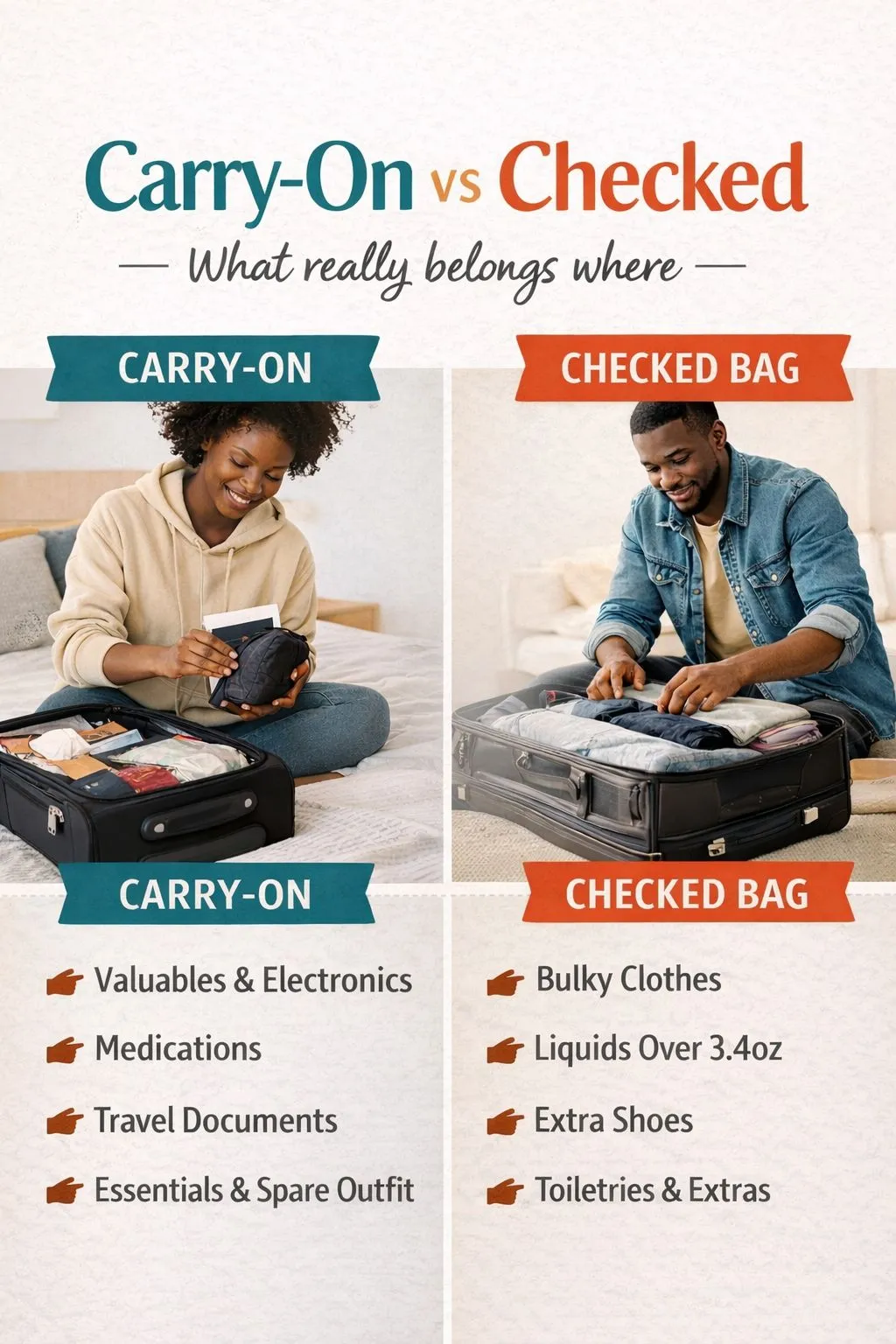
Reliability improves as well. When luggage stays with the passenger, the risk of delayed, lost, or mishandled bags drops to nearly zero. Valuables, medications, and essential documents remain accessible throughout the journey.
Many travelers also find that packing less reduces decision fatigue and encourages more intentional packing. With practice, a well-organized carry-on using compression cubes and a capsule wardrobe approach can comfortably cover a week or more in moderate climates.
When Checked Luggage Still Makes Sense
Carry-on only is not ideal for every trip. Longer journeys—typically those lasting more than a week—often require more clothing changes, especially when laundry options are limited. Cold-weather destinations demand bulky coats, boots, and layers that quickly exceed cabin-bag dimensions.
Specialty gear is another clear case for checking a bag. Ski equipment, hiking boots, formalwear, or sports equipment rarely fits comfortably in a standard carry-on. Families traveling with young children may also find checked bags more practical for strollers, car seats (often free), and extra supplies.
Liquid restrictions further influence the decision. Cabin rules limit containers to 3.4 ounces (100 ml) and require them to fit in a single quart-sized bag. Travelers who need full-size toiletries, specialty products, or larger quantities often prefer to check those items.
In these situations, the convenience and capacity of a checked bag frequently outweigh the fee, particularly when the alternative would involve buying replacements at the destination or compromising on necessary items.
Practical Considerations Beyond Cost
Airport experience differs significantly between the two approaches. Carry-on travelers can check in online, proceed directly to security, and board without stopping at a bag drop. On arrival, they exit quickly. Checked-bag travelers must allow extra time for drop-off and collection, and they face the possibility of delays at the carousel.
Space constraints also matter. Overhead bins fill up on busy flights, sometimes forcing gate-checking of carry-ons. Choosing a bag that reliably fits airline sizers (commonly around 22 x 14 x 9 inches) reduces this risk. Soft-sided or well-designed hard-shell bags that maximize interior volume help travelers stay within limits while packing efficiently.
Hybrid strategies work for some trips. Travelers may wear their bulkiest items, pack a carefully curated carry-on, and check only what cannot be reduced. Others use a personal item plus a carry-on and accept that laundry or minimal shopping may be needed on longer stays.
Making the Decision for Your Trip
The right choice depends on trip length, climate, activities, and personal priorities. For short city breaks, business travel, or mild-weather trips under a week, carry-on only usually delivers the best combination of cost savings, speed, and simplicity. For longer stays, cold destinations, or gear-heavy itineraries, a checked bag often proves more practical and less stressful.
Running the numbers helps. Calculate the round-trip bag fee, estimate any extra costs that packing light might create (laundry, replacements, or purchases), and weigh those against the value of time saved and peace of mind. Many travelers find that investing in good packing tools—compression cubes, versatile clothing, and a high-quality carry-on—pays for itself within a few trips by eliminating fees.
The Bottom Line in 2026
Traveling light remains worth it for a large share of trips, especially as checked-bag fees have climbed. The combination of direct cost savings, faster airport experiences, and reduced risk of lost luggage makes carry-on only an attractive default for many people. At the same time, checked luggage retains clear advantages when capacity, specialized items, or trip length demand it.
The most effective approach is not rigid loyalty to one method, but a clear-eyed assessment of each journey. By understanding current fee levels, packing smarter, and matching luggage strategy to the specific needs of the trip, travelers can keep costs under control while maintaining comfort and convenience. In 2026, the smartest packing decision is the one that aligns with both the itinerary and the traveler’s priorities.
Read more – gloryhouseworld.com